
Friday Digital Roundup
The Friday Digital Roundup is a witty take on the weird world of the internet. With fun stories from around the globe, it’s the only email newsletter you’ll actually read and enjoy!
We do love writing it, but clearly not as much as people like receiving it - just look at the response we got when a technical hitch meant it wasn’t sent out on time!
@roisinduffyVA @roisinduffyva
@Spaghetti_Jo
Coffee and the FDR is how I start my Friday.
Do not engage until I have devoured both
Meschi Consultants @MeschiConsult
When it comes to the end of the week, there is no better way to start a Friday than with a run around the internet with Todd and Jo in the FDR. Just don't let them know I do it from the loo!
Kathryn Lynch-Smith @KikikatSmith
@Spaghetti_Jo
My inbox is full of rubbish newsletters that Im constantly deleting😬 My VIP inbox is for 1 thing only- THE DIGITAL ROUNDUP🤠I dont read a Newspaper or the news online, I just wait for Fridays, when this lands in my inbox- then I know ‘The weekend has landed’🤗
Get the Friday Digital Roundup and see what everyone’s talking about.
We may look like cowboys, but we’ll never abuse your data! Find out what we’ll do with it here, partner.
Spaghetti Blog
Saturday 17th October 2026
The Top 15 Social Media Marketing Questions Businesses Ask Us (Answered for 2026)
For more than 10 years, we’ve been helping businesses with their social media – sometimes through our social media training, sometimes by doing it for them. Either way, in that time, we’ve been asked some really interesting questions.
I’ve long been known for saying that stupid questions are perfect for marketing.
And by that, I mean stupid questions are often frequently asked questions.
How often have you heard someone say: “This might be a stupid question, but…”
Those questions are absolute gold for your content.
The moment someone says they have a stupid question, your ears should prick up. Get your pen out. Or your phone. Or your dictation tool. Because what they’re really giving you is the exact thing other people are also wondering, searching for, and worrying about.
That’s brilliant content.
In fact, if you take nothing else from this blog, take this: the best content for your business social media strategy usually comes from the questions your customers ask all the time.
They might sound obvious to you because you work in your industry every day. But to your audience? They’re important. They’re useful. They’re searchable. And if enough people are asking them, they become content that improves your professional social presence and strengthens your business credibility online too.
So here are the top 15 social media marketing questions we’ve been asked over the last 12 months.
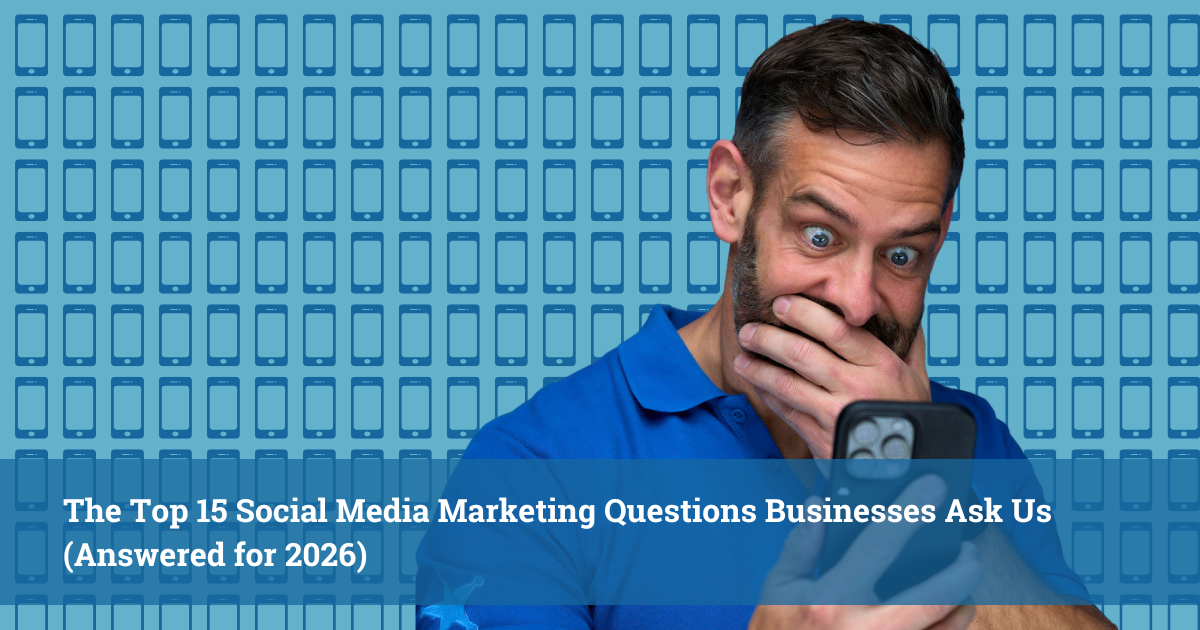
The Top 15 Social Media Marketing Questions Businesses Ask Us (Answered for 2026)
1. Do followers still matter, or is it all about reach and engagement?
This is a brilliant question because the answer has changed massively over the last few years.
The short answer is: followers matter less than they used to. It’s now much more about reach and engagement. And honestly? Mostly reach.
Think about how you use social media yourself now. You probably don’t follow people anywhere near as much as you used to. And you probably don’t engage as much either. Most people barely comment anymore. Loads of people don’t even hit like.
Instead, we consume content silently. If we watch enough of something, the algorithm simply gives us more of it.
The platforms are engineered to keep people watching, so what they care about is whether your content holds attention. That’s why good content matters more than big follower numbers.
Now, it’s still nice to have loads of followers – we all like a little vanity metric. But follower count on its own isn’t the thing that grows your business anymore. What matters is: are people seeing your content? Are the right people seeing your content? And does that content help build trust? Because trust is what supports your sales pipeline and builds business credibility online.
2. What should we actually post, how often, and on which platforms?
You should post the content your ideal customers care about. Honestly, it’s that simple.
Right at the beginning of this blog I mentioned listening to the “stupid questions”. Well, if you answer the questions people constantly ask you, you’ll create content people actually want to consume. We’re literally doing it right now with this blog.
Time and again, people entering our sales pipeline tell us they heard something on a podcast, a blog, a social media post, a talk, or an event – and it resonated with them. Most of the time, the thing that resonated was something we thought was basic. That’s the trick. What feels obvious to you is often massively valuable to someone else.
As for how often you should post? As often as you realistically can while still maintaining quality and consistency.
And where should you post? Post where your audience actually is. If your customers spend time on LinkedIn, post there. If they live on Instagram, create content there. If they’re watching video content all day, you probably need video too.
The mistake businesses make is trying to be everywhere at once. You don’t need to dominate every platform – you just need a professional social presence in the right places. If you’re struggling to create enough content consistently, this is exactly why businesses invest in content creation packages or outsource parts of the process altogether.
3. How do we use reels, videos, and TikTok properly without it taking over our lives?
This is a very fair question because video absolutely can eat your time alive. Usually, it’s not even filming that takes the time – it’s editing.
That said, there are now loads of tools that speed things up: CapCut templates, AI clipping tools, auto-captioning, and editing shortcuts. But even with all that, video still takes effort.
When we create content for social media clients, we can easily spend three to four hours a month just on video. Sometimes much more if we’re going heavy on production.
But here’s the thing: one of the best ways to stop social media taking over your life is to document instead of create. That means:
- filming while you work
- recording podcasts
- taking photos at events
- turning emails into posts
- dictating blogs
- capturing conversations as they happen.
The businesses that struggle most with social media are often the ones trying to “sit down and create content”. The ones doing best are usually just documenting what they already do.
4. How do we turn social media into actual leads, bookings, and clients?
This is where people often misunderstand social media completely. Social media rarely drives direct sales immediately. It’s very difficult to point at one Instagram post and say: “That post made us £10,000.” That’s not really how it works.
Social media supports the buying journey. It helps people trust you before they enquire.
Far too many businesses treat social media as its own isolated marketing silo and then judge it purely on direct conversions. But it doesn’t work in isolation. It needs your website, networking, podcasts, referrals, events, email marketing, SEO, and reputation – all working together. That’s why investing in your social media strategy and management matters so much. What social does brilliantly is support trust and credibility during buying decisions. People often discover you elsewhere and then check your social media before buying.
5. How do we know what’s actually working?
This is where social media reporting gets messy – because reports never tell the full story. Yes, you can look at reach, impressions, demographics, engagement, clicks, and follower growth. But that’s still only a snapshot.
What really matters is whether your content supports business growth. When people enter our sales pipeline, we ask them: “Why did you choose us?” Loads of them mention social media content – not because they found us there initially, but because it helped validate us during the buying journey. That’s a huge difference.
So yes, look at your reports. But don’t become obsessed with vanity metrics while ignoring the bigger business picture.
6. What should we do on LinkedIn, and how is it different from other platforms?
This question always makes me laugh because people massively overthink LinkedIn. Everyone treats it like a strange corporate networking event where you suddenly have to become “professional”.
Humans are humans. The same people on LinkedIn are also on Instagram, Facebook, and TikTok. If your content resonates elsewhere, it can resonate on LinkedIn too.
The content that usually performs best is personal, conversational, honest, opinionated, and relatable. Not stiff corporate waffle written by someone terrified of upsetting Sharon from accounts. You don’t need to suddenly become a robot because you opened LinkedIn.
7. How should we run ads on Meta, Instagram, and TikTok?
This is honestly an entire blog on its own. But the simple version is: your targeting needs to be right. You need to understand who you’re targeting, what problems they have, what they care about, and what they’re struggling with.
Then your creative needs to speak directly to that – whether that’s video, copy, images, graphics, testimonials, or hooks. Beyond the advert itself, the landing page journey matters too. Does it load properly? Does it convert? Does it build trust?
One huge mistake businesses make is trying to sell very expensive services directly from cold social ads. High-ticket services usually require nurturing, retargeting, authority, content, and trust. That’s why social media ads work best as part of a wider marketing strategy rather than a magic money machine.
8. How do we keep up with algorithm changes and AI?
Everyone thinks they’re behind with AI right now. The truth is, we’re all behind – which means nobody is behind. Even the people building AI tools are making it up as they go along half the time. So stop panicking. Start experimenting instead.
Use AI to speed up workflows, repurpose content, organise ideas, structure blogs, and improve efficiency. But don’t let it replace your personality. The problem with generic AI content is that everyone starts sounding exactly the same – and if everyone sounds the same, nobody stands out.
AI should support human content, not replace it. That’s especially important now because platforms are increasingly identifying AI-generated material. My prediction has always been the same: stay human, be authentic, be conversational. While everyone else is publishing polished AI sludge that sounds like it was written by a corporate toaster, the businesses speaking like actual human beings will stand out massively. And if you care about ranking in AI search and Google moving forward, conversational human content matters even more – which is why we’re investing heavily in AI SEO and GEO strategy rather than simply mass-producing robotic content.
9. How do we organise social media properly with access, passwords, and workflows?
Honestly? Most businesses are terrible at this. Nearly every client we onboard has weak password security.
Every single platform should have a unique password, encrypted password management, two-factor authentication, and multiple trusted admins – especially on Meta Business Manager. You’d be amazed how many businesses lose access to accounts because one person leaves, forgets passwords, or gets hacked.
And please: never send passwords over WhatsApp or text. That’s not security – that’s chaos. Boring security is much better than losing your Instagram account overnight.
10. How do we repurpose blogs, podcasts, and talks into social content?
This is one of the best things businesses can learn. At Spaghetti, we’ve always believed in creating one large piece of content first and then repurposing it. That’s exactly what we’re doing with this blog.
A blog can become: LinkedIn posts, Instagram captions, email newsletters, podcast snippets, reels, speaking topics, FAQs, carousels, and short videos. AI tools can massively speed this process up too – but the important thing is human refinement afterwards. The businesses getting the best results from AI are the ones guiding the process rather than outsourcing all thinking to the machine.
11. How do we keep social media consistent with our brand voice?
You need brand guidelines. But let’s be honest: nobody reads brand guidelines properly.
What we’ve started doing instead is training custom GPTs and AI systems on tone of voice – allowing multiple people within a business to create content while still sense-checking whether it sounds right. Ironically, this blog was created exactly that way. I dictated it, AI transcribed it, then we refined it through our tone of voice process.
That workflow works brilliantly because conversational content performs better anyway – especially for SEO, GEO, and AI search. Speaking naturally is becoming a competitive advantage online.
12. How do we balance professional and personal content on LinkedIn?
People massively overcomplicate this. The fact people even ask this question usually means they’re scared of posting the wrong thing.
The core question is simple: who are you trying to attract, and how would you realistically speak to them in real life? That’s usually your answer. The most engaging LinkedIn content is almost always personal, story-driven, opinion-led, emotional, and human. You don’t need to post selfies crying in your car – but people do connect with people far more than they connect with polished corporate jargon.
13. What should our social media strategy be for the next three to six months?
One of the easiest things we’ve done over the last couple of years is theme our quarters. Right now, we’re in a social media quarter – which means blogs, podcasts, speaking topics, and events all align around the same theme.
Within that broader theme, we create smaller content pillars: video marketing, paid ads, content creation, LinkedIn, AI tools, strategy, and branding. This makes content creation far easier because you stop reinventing the wheel every day.
A proper business social media strategy should support wider business goals – not just random posting for the sake of it.
14. How do we avoid getting hacked?
Get two-factor authentication switched on. Seriously. Nearly everyone I’ve met who got hacked didn’t have proper security enabled.
Meta Business Manager should always have at least two admins, strong passwords, two-factor authentication, and secure recovery options. If you do lose access, Meta support can sometimes help – and getting hold of them can feel like trying to summon a ghost through interpretive dance. So prevention is massively better than cure. Protect your assets properly from day one.
15. How do we stop social media from eating all our time while still getting results?
The honest answer? Good social media takes time. That’s just reality – which is why so many businesses eventually outsource it.
Typically, we spend between 15 and 20 hours per month on client social media management. That’s a significant amount of work. But again, the trick is integrating content into your day-to-day life rather than treating it as a completely separate task.
Document exhibitions, meetings, podcasts, ideas, voice notes, conversations, and customer questions. That way, content becomes a by-product of running your business rather than another exhausting task on your to-do list.
Final thoughts
So those are the top 15 social media marketing questions we’ve been asked in the last year. And honestly? They’re brilliant questions – even if people are often nervous about asking them.
Remember: when someone says “this might be a stupid question…” – pay attention. Because those questions often become the best marketing content you’ll ever create. If lots of people ask the same thing, lots of people are searching for it, and lots of people will engage with content around it.
That’s how you create content that’s useful, searchable, and genuinely valuable. And in a world full of generic AI-generated noise, useful human content is becoming more important than ever.
If you want help building a better professional social presence, improving your business credibility online, or creating a proper business social media strategy, find out more about our social media and marketing services, our content and copy packages, and our consultancy and strategy support.
And if you’ve got any other questions, stick them in the comments. There’s a good chance they’ll become the next blog.
Want help with your social media strategy? Get in touch with the Spaghetti team today.
Do You Struggle to Create Content to Generate Sales?
We’ve Created a FREE Online Marketing Plan…
Use our simple ideas generator to help you make better content, over and over again…
Tags associated with this article
Post a comment
We'd love to know what you think - please leave a comment!
99 Simple Marketing Tips
99 Simple Marketing Tips You Can Use to Treble Your Business
Struggling to know where to start with your digital marketing?
We’ve got a tonne of ideas that you can put in place for your marketing – directly from our past 8 years growing an engaged following and strong business.
What You’ll Get
- #ToddsTips
- 4Networking
- AI
- Blogging
- Brand
- Business
- Case study
- Content
- Content Marketing
- Copywriting
- Digtial Marketing Trends
- Email marketing
- Facebook Ads
- Facebook Groups
- Facebook Live
- Google Adwords
- Hashtags
- How to
- Marketing
- Marketing strategy
- Networking
- Outsourcing
- PPC
- PR
- Press Releases
- Proofreading
- SEO
- Social
- Social Media
- Spaghetti Agency
- Storytelling
- Technology
- Video
- Video marketing
- Vision
- Websites
- Workshops
- YouTube




0 comments on this article